Home · Makers
Heritage furniture makers
The makers: three centuries of the British upholstery trade
Every period on this site has its makers — the upholders of Stuart London, the cabinet-makers who published pattern books, the Victorian firms that patented springs, the post-war designers who put foam on splayed legs. This section follows that trade, and profiles two Salford workshops that still build sofas the traditional way.
In brief. British sofa-making was a London craft of upholders and cabinet-makers in the eighteenth century, became a factory industry in the Victorian Midlands and North, and survives today as a small number of workshops that still cut frames, tie springs and hand-button covers. The two makers profiled here are trading names of one Salford company, Forest Sofa Ltd, and are included because they operate this site.
Who made sofas before there were brands?
The trade that built the first fixed upholstery was the upholder. In seventeenth-century London the upholder stuffed and nailed; the joiner or chair-maker built the frame; and for royal and state furniture the orders came through the Great Wardrobe. The name survives in the Furniture History Society’s dictionary of British makers, and the V&A catalogues the chair made for Bishop Juxon in 1661 under its upholsterer, John Casbert. The Origins page follows that trade from the Knole couch to the first settees.
The pattern-book makers, 1754–1837
The eighteenth century turned individual craftsmen into national names. Thomas Chippendale’s Gentleman and Cabinet-Maker’s Director of 1754, sold from his premises in St Martin’s Lane, carried one London style to every provincial workshop; Hepplewhite’s Guide and Sheraton’s Drawing-Book followed. In Lancaster, Gillows supplied the North and the colonies, and their 1805 Grecian couch for Kinmel Park is one of the best-documented Regency sofas in a museum collection. The Georgian & Regency page covers the pattern books and the makers behind them — and the London upholsterer Samuel Pratt, whose coil-spring patents of the late 1820s changed the inside of every sofa that followed.
The Victorian firms and the sprung seat
Springs, buttoning and the Great Exhibition made upholstery an industry. Howard & Sons of Berners Street took out their “Elastic Seats” patent in 1866 and held a royal warrant by 1901; Morris & Co answered the over-stuffed parlour with the Sussex chair and the reaction that became Arts and Crafts. Manufacturing spread from London to the furniture towns — High Wycombe for chairs, and the mills and workshops of Lancashire and Manchester for upholstery. The Victorian page has the Chesterfield, the Howard easy chair and the firms that made them.
Heal’s, Hille, Ercol and the post-war designers
Ambrose Heal’s Tottenham Court Road shop made the plain, well-made piece a middle-class ideal before 1914; Gordon Russell’s Utility scheme imposed it on everyone between 1942 and 1952; and the Festival of Britain in 1951 handed the baton to a new generation — Robin Day at Hille, Ernest Race, Lucian Ercolani at Ercol, Parker Knoll with its 1966 recliner. The Edwardian, Interwar, Mid-century and 1970s–1990s pages each name their makers and the museum objects that document them.
Who still makes sofas by hand in Britain?
Fewer firms than there were, but the method has not changed as much as the materials have. A traditional British sofa workshop still cuts a hardwood frame, fixes a sprung platform to it, builds up the padding in layers, cuts and sews the cover and — if it is a Chesterfield — pulls the buttons through by hand. The two profiles below describe how that is done today at the Ford Lane workshop in Salford, where this site’s operator makes sofas under two names. They are written from the makers’ own published information and from public records; where a claim could not be verified independently it is marked as the maker’s own.
Two makers in Salford
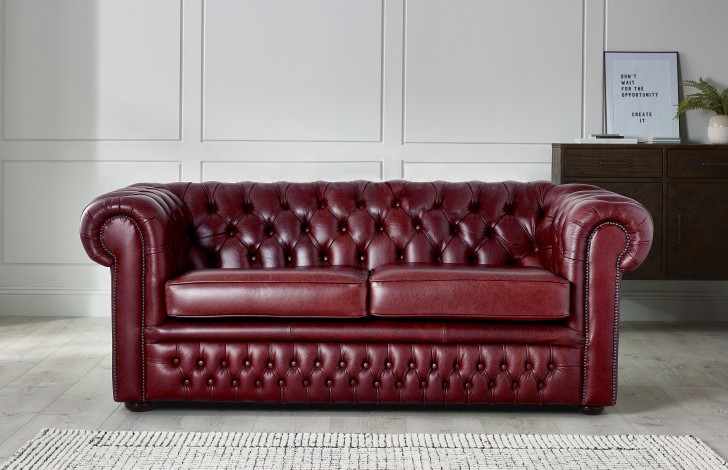
Profile
The Chesterfield CompanyDeep-buttoned leather Chesterfields made at Ford Lane, Salford, on solid beech frames with serpentine springs; the company dates its Manchester manufacturing to 1951.
Read the profile →
Profile
The English Sofa CompanyA broader range — Chesterfields, Art Deco, chaises, sofa beds and modular — handmade in purpose-built workshops in Manchester and Lancashire, with more than 150 fabric and leather options.
Read the profile →Both names are trading names of Forest Sofa Ltd (Companies House no. 05170110, incorporated 2004, registered office Ford Lane, Salford M6 6PD), which also operates The Sofa Collection. Nothing on this site is for sale.