Home · Georgian & Regency
1714 – 1837
The Georgian and Regency sofa: from walnut settee to Grecian couch
In 1714 a settee was a wide walnut chair made for a state room. By 1837 a sofa stood in the drawing room of an ordinary town house. This period follows that descent through the pattern books, the mahogany trade, Adam’s gilded suites and the Regency scroll arm — and stops at the moment a London upholsterer patented the coil spring.
In brief. Between 1714 and 1837 the sofa stopped being a state object and became drawing-room furniture: walnut gave way to mahogany, the chair-back settee and the fully stuffed sofa appeared side by side, and by 1830 the Museum of the Home can say that sofas had become common in ordinary homes. The engine of change was print — Chippendale’s Director of 1754, Hepplewhite’s Guide of 1788, Sheraton’s Drawing-Book and Thomas Hope’s Household Furniture of 1807 — which carried one national style to every provincial workshop. Under the cover the method was still stuffed-over horsehair on linen webbing, until the coil spring, patented by the London upholsterer Samuel Pratt in the late 1820s, arrived as the period closed.
- Earliest dated settee here
- 1722Carved walnut, gilt and gesso, from Glemham Hall, Suffolk
- The pattern book
- 1754Chippendale’s Director, sold from his house in St Martin’s Lane
- Neoclassical sofa
- 1764–65Adam design, Chippendale make, for Sir Lawrence Dundas
- The Grecian couch
- 1805Gillow’s gilded couch for Kinmel Park, with bolster and squab
- The coil spring
- 1820sSamuel Pratt, upholsterer, patentee of the coil upholstery spring
What did an early Georgian settee look like?
An early Georgian settee was a chair frame stretched wide: a walnut or gilt-gesso frame on cabriole legs, a tall raked back, out-swept scrolled arms and a cover of the richest silk the house could afford. The V&A’s settee of 1722 from Glemham Hall in Suffolk is exactly this — carved walnut, gessoed and gilded, its arched seat rails carved with lambrequins and acanthus, its upholstered back and arms covered in a brocade of green, salmon and silver edged with silver braid. It belongs to a set, and it was made, the museum suggests, when alterations were carried out at the hall; a settee in 1722 was still commissioned with the room, not bought from stock.
What lay under that brocade is known from a suite made ten years later. Around 1732 Sir Robert Walpole furnished the State Apartment at Houghton Hall in Norfolk; William Kent designed the state bed, but the seat furniture was, in the V&A’s view, entirely the work of the chair-maker Thomas Roberts junior. The sofa is carved and gilded walnut on cabriole legs with lion masks and paw feet, covered in green silk velvet trimmed with braid and cord. Its companion chair keeps its original stuffing: linen webbing, a linen ticking base cloth, horsehair and linen stuffing covers, with a loose velvet cover over the top and a “scarf” stitched across the back to protect the silk from hair powder. That is the whole Georgian method in one object, and it would not change in substance for a hundred years.
The grandest version is William Hallett’s settee of 1735–40, made in London for Palladian parade rooms: walnut carved with cornucopiae, swags of fruit and satyr masks, a Greek key along the seat rail, the seat and back in silk damask, and originally oil-gilded all over. Below this level, fashion was home-made. A canvaswork settee cover of 1728–40 in the V&A, worked in wool and silk in tent and cross stitch, was one of a set with six chair covers, embroidered by an amateur — probably a woman working at home — from William Kent’s illustrations to Gay’s Fables. The Museum of the Home’s parlour of 1745 shows the middling result: wooden chairs with red cushions round a tripod table, and no sofa at all.
Why did mahogany replace walnut?
Mahogany replaced walnut because it could be carved crisply, spanned wide seat rails without joints, and took a polish that suited the sharper lines of mid-century design; by the 1760s it was the wood of the best London seat furniture. The sofa at Nostell Priory in Yorkshire, dated about 1765–70 and attributed to Chippendale’s firm at St Martin’s Lane, is a mahogany frame on beech: a rectangular padded back, a seat with a loose cushion between scroll-over arms, four square-section legs with raked back feet. Its legs match a set of twenty-one chairs that Chippendale probably supplied in 1766, and the National Trust calls the library table he sent to Nostell in 1766–67 the finest piece of mahogany furniture he ever made.
The same wood made possible the double-chair-back settee, a form that treats a sofa as two or three chairs joined at the hip. The V&A’s mahogany chinoiserie settee of about 1750–75 is carved in the solid with pierced fretwork in its two raked chair backs and swept arms, on six square legs joined by pierced stretchers, with an upholstered seat — and the museum warns that many surviving settees of this type were actually made between about 1850 and 1900. Chair-back settees sit at one end of the period’s range; at the other stands the fully stuffed sofa, and the two coexisted for the rest of the century.
Milestone · 1754
The pattern book makes a style national
In 1754 Thomas Chippendale published The Gentleman and Cabinet-Maker’s Director, printed for the author and sold at his house in St Martin’s Lane. The V&A’s copy runs to 161 leaves of plates, many showing alternatives for the form and decoration of a single piece, and the museum calls it the most influential furniture pattern book ever produced. Chippendale issued it to attract business, and its subscribers included clients and other cabinet-makers in London, throughout Britain and overseas — which is precisely the point: a provincial chair-maker who owned the book could produce a London sofa without ever having seen one. The Director went through three editions; a pen-and-wash design for a rococo sofa in the V&A became the lower half of plate 30 in the 1762 edition, and the plates carried instructions on the sofa’s dimensions to help the cabinet-maker adopt them. This is the serpentine or “camelback” sofa of the mid-century: a stuffed back rising in a curve to the centre, rolled arms, cabriole or square legs beneath.
Two more books completed the set: George Hepplewhite’s Cabinet-Maker and Upholsterer’s Guide, published in London in 1788, and Thomas Sheraton’s Cabinet-Maker and Upholsterer’s Drawing-Book, of which the V&A’s copy is the 1802 edition with 123 engraved plates. The titles say what had happened to the trade: cabinet-maker and upholsterer were now one business, and the sofa was its product.
What did Robert Adam and neoclassicism do to the sofa?
Neoclassicism turned the sofa into architecture: designed by the architect for a specific wall, carved with the same ornament as the ceiling, and often gilded. The earliest example in the V&A is the settee designed by James “Athenian” Stuart and carved by Thomas Vardy in 1759–65 for the Painted Room at Spencer House, a limewood frame on eight legs with winged lions forming the legs and arm supports; Stuart, one of the first British architects to work in the new style, took the idea from Greek and Roman stone thrones. Robert Adam went further. For the drawing room at Kedleston Hall he designed a pair of sofas, made by John Linnell and delivered in July 1765, three metres twenty long, their giltwood legs formed as tritons and sea-nymphs among dolphins, the seats, backs and arms in flowered blue silk brocade with five loose bolsters to each sofa.
For Sir Lawrence Dundas at 19 Arlington Street, Adam drew in 1764 a set of “sopha chairs for the salon” that Thomas Chippendale then made — the only known case of Chippendale executing an Adam design. Chippendale’s bill for the eight armchairs, at £20 each, is the best short description of a fashionable seat of the 1760s: “exceeding richly carved in the Antick manner and gilt in oil Gold stuff’d and cover’d with your own damask and strong Castors on the feet”. The client supplied the silk; the maker supplied frame, stuffing and castors; four sofas completed the set. The National Trust’s houses show the style spreading — giltwood seat furniture attributed to Chippendale in the Saloon at Saltram, paid for in 1771–72, and at Petworth a partitioned giltwood sofa with a serpentine back and two corner seats, probably of 1777–79. By the 1790s the taste had lightened: Gillow & Co’s mahogany armchair of about 1787–95 in the V&A has an open heart-shaped back, tapering legs and a seat in horsehair cloth, while the Museum of the Home’s parlour of 1790 is still a room of wooden chairs and a folding card table.
What is a Grecian couch, and what makes a sofa “Regency”?
A Grecian couch is a single-ended reclining sofa with one high scrolled end, a lower foot, and a back that often runs only part of the way along — the Regency’s reinterpretation of the ancient kline, arriving in England around 1800. The V&A’s example was made by Gillow & Co in London in 1805 for the drawing room at Kinmel Park in Denbighshire, part of a suite of couches, armchairs and sofas for the Reverend Edward Hughes. It is carved and gilded beech, two metres long, with Egyptian-style lion terminals carved with lotus leaf, paw feet, a curved rest, a long squab cushion and a bolster at the head — animal legs, bolster and low scrolled foot being what the museum calls the Classical taste of the early nineteenth century.
The taste had a manifesto. Thomas Hope (1769–1831), a Dutch-born collector, bought Robert Adam’s house in Duchess Street in 1799, remodelled it with themed interiors drawn from Greece, Rome and Egypt, opened it to society in 1802, and in 1807 published Household Furniture and Interior Decoration, which the V&A credits with bringing the phrase “interior decoration” into English. The lighter end of the style was already in the shops: the V&A’s “Trafalgar” chair of about 1810, ebonised with a rope-twist back rail, has the continuous curve from back to sabre leg that the museum calls Grecian, from a design published in 1808.
The Regency sofa proper — the piece most people picture — is the double-ended form with scrolled arms of equal height, a straight or slightly curved back, sabre or turned legs and brass castors. The sofa in the South Drawing Room at Sir John Soane’s Museum is the domestic version: mahogany, scroll arms banded diagonally halfway down, squat legs on brass castors, two tasselled cushions. The museum’s inventory describes the room’s original sofa as having a “stuffed back and ends, hair cushion and two pillows, the whole with chintz covers”. At the top of society the same form was gilded: for George IV’s private apartments at Windsor Castle, Morel & Seddon made a suite of fifty-six pieces, twelve sofas among them, in carved and gilt mahogany with lion-paw front feet and sabre back legs, covered in blue, green or crimson silk damask. One Windsor sofa in the Royal Collection has outscrolled arms carved with lotus leaves — the arm every later “scroll-arm” sofa descends from.
Two smaller objects record what these sofas were made of. A chair squab supplied by Morel and Hughes to Northumberland House in 1823 — “a seat cushion to each of horsehair in canvas” — is black and white horsehair in a linen case, its border joined to the panels with very fine over-stitching, a row of top stitching along the edge and three rows of running stitch below, the creases of a tufting pattern still visible; its cover was grey silk striped with rosettes. And at Stourhead, Thomas Chippendale the younger’s invoice of May 1805 for eight mahogany and cane library chairs adds cushions “covered with fine Athenian red cloth” and one “covered with yellow leather”. Striped silk in the drawing room, leather in the library: the Regency division of coverings was settled.
By the end of the period the sofa had reached the middle of society. The Museum of the Home’s drawing room of 1830 is built around a sofa of about 1820 in blue upholstery on tapered legs with curved arms, and the museum states that sofas became common in homes in the early 1800s and were much more comfortable than earlier seating as the living space grew more informal. The mother reads fashion magazines on it while her daughters paint and write letters — the sofa being used, at last, as one is used today.
Milestone · 1820s
The coil spring enters the seat
The Furniture History Society’s dictionary of British makers records Samuel Pratt of New Bond Street, London — a trunk-maker turned upholsterer, in that trade from 1826 to 1847 and upholsterer “to their Majesties” — as the patentee of the coil upholstery spring, under patent numbers 5418 and 5668. His firm advertised “Elastic Beds, Easy Chairs &c. Stuffed with Iron Wire” and “Patent Stuffed Recumbent Chairs”, and supplied Lord Leigh in 1833 and Stafford House in 1838. The date usually given for the spiral-spring patent is 1828, but the dictionary lists the numbers rather than the year, so the safest statement is that the coil spring is first recorded in English upholstery in the 1820s and early 1830s, and that in 1837 it was still a novelty confined to expensive beds and easy chairs. None of the sofas on this page was sprung when it was made. The sprung seat, and the deep-buttoned Chesterfield that depends on it, belong to the next period.
How was a Georgian sofa upholstered?
A Georgian sofa was “stuffed over”: the upholsterer built the seat directly on the frame rather than dropping in a separate cushion. The Roberts chair of 1732 and the Northumberland squab of 1823 between them supply the recipe. Linen webbing was tacked across the beech seat rails; a linen base cloth went over it; horsehair was teased and laid on the cloth; a linen stuffing cover was tacked over the hair and the whole stitched through with twine to stop the hair migrating. The stitching along the edge, which pulls the hair into a firm rolled lip and gives the seat its square front, is what upholsterers still call a hair-stitched edge; the trade name “French edge” for the more elaborate version is a later usage not traced here to a museum record. Over the linen went the show cover — velvet, damask, brocade, horsehair cloth or leather — nailed round the rails, the nail heads hidden under braid or displayed as a row of brass domes, with loose hair or feather cushions and bolsters on top. The frame was show-wood, meant to be seen: walnut on beech rails to about 1740, gilt beech or limewood for state suites, mahogany from mid-century, painted or gilded beech in the Regency, and castors underneath, which Chippendale charged for in 1765 and which Soane’s sofa still runs on.
Materials: what went where, and why
| Period | Frame | Filling | Cover | Construction |
|---|---|---|---|---|
| Early Georgian, 1714–40 | Walnut, often gilt or gessoed; beech rails; fir, oak and ash secondary | Horsehair on linen webbing and ticking base cloth | Silk velvet, brocade, damask; canvaswork; loose covers over silk | Stuffed over; linen stuffing cover; braid and cord; protective “scarf” on back |
| Mid-Georgian, 1740–70 | Mahogany carved in the solid; beech secondary; giltwood for state rooms | Horsehair; loose seat cushion on some sofas | Damask supplied by the client; needlework; leather | Chair-back settees with fretwork; serpentine stuffed sofas to Director dimensions; castors |
| Adam and Hepplewhite, 1760–95 | Giltwood (limewood, beech); mahogany with tapering legs | Horsehair; bolsters and pillows | Silk brocade and damask; horsehair cloth on mahogany chairs | Architect-designed suites for a room; stuffed and covered by the maker |
| Regency, 1800–30 | Mahogany, gilded or painted beech; sabre and animal legs; brass castors | Horsehair stitched in canvas; feather pillows | Striped silk, silk damask, chintz, black horsehair, leather in libraries | Stuffed back and ends; squab and bolster; loose chintz covers |
| Late Regency to 1837 | As above; heavier turned legs | Horsehair; iron-wire coil springs in the newest beds and easy chairs | Silk, chintz, haircloth, leather | Pratt’s “stuffed with iron wire” seats appear; sofas still mostly unsprung |
Leather or fabric?
The room decided it. In the drawing room and the state apartment the cover was silk — velvet at Houghton, brocade at Glemham and Kedleston, damask at Arlington Street and Windsor — often bought by the client and handed to the upholsterer, as Dundas did. Silk was the expensive part of the piece and was protected with loose covers; the Soane inventory’s “the whole with chintz covers” shows a sofa spending most of its life in its slip cover. Striped silks with small repeats, like the grey silk with rosettes at Northumberland House, suited the Regency’s flat surfaces. Horsehair cloth — glossy, cool and almost indestructible — covered dining and library chairs from the 1790s, and the Soane sofa was in black horsehair until 1984. Leather was the library material: the yellow-leather cushion in Chippendale the younger’s Stourhead bill sat among red cloth ones because its chair would be used hard, and the pattern held for a century. The canvaswork and Turkey-work covers of the early period faded from fashion as the century went on; needlework belonged to the walnut age, and the mahogany or giltwood sofa wanted the plain shine of silk.
What survives in a sofa made today
Six ideas from the Georgian and Regency century are still in production. The comparisons below pair each with a piece made in England today; they are there to make the lineage visible, not to suggest the modern pieces are reproductions — not least because every modern piece is sprung, and none of the originals was.
Then · 1722–1790
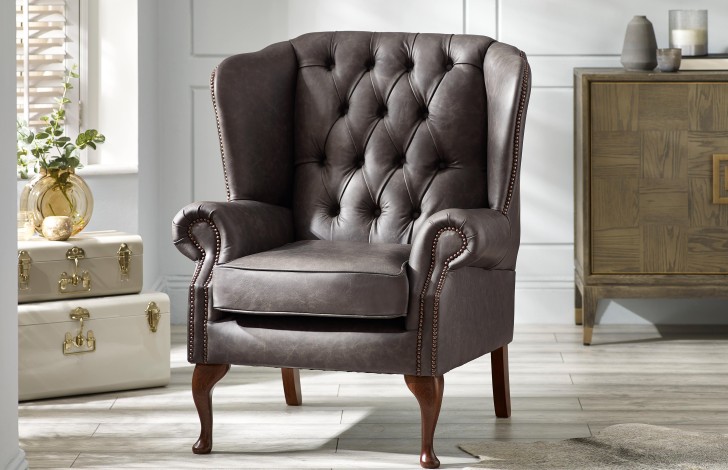
The wing chair on cabriole legsThe walnut and mahogany armchair of the Georgian parlour: a tall stuffed back, scrolled arms, cabriole legs and a nailed cover.
Now · The Chesterfield Company
Regency flat wing chairQueen Anne legs, a flat wing and a line of brass studs — the Georgian easy chair with a sprung seat.
See the flat wing chair →Then · 1754–1830
The scroll-arm sofa with a high stuffed backFrom Chippendale’s serpentine sofa to the Regency scroll: rolled arms, a tall stuffed-over back and brass nails along the rails.

Now · The English Sofa Company
Portland leather sofaScroll arms, a high back and hand-applied studs on the arm fronts — the Georgian outline with feather-wrapped cushions the eighteenth century never had.
See the Portland →Then · c. 1700–1750
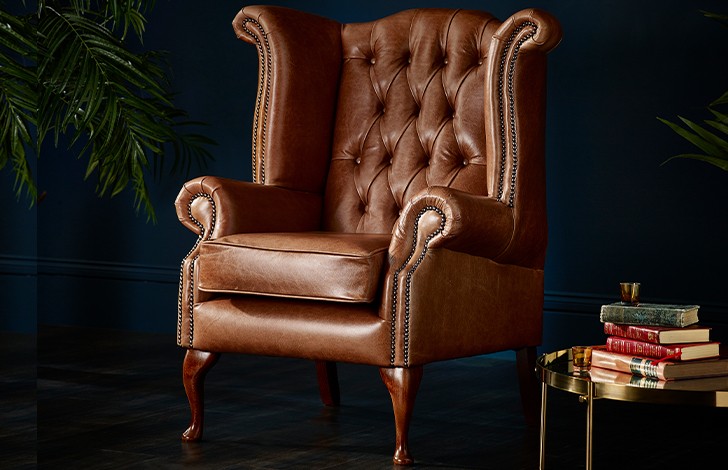
The cabriole leg and the scrolled wingThe “Queen Anne” walnut chair: a curved cabriole leg ending in a pad foot, and wings that scroll outward to shield the sitter from draughts.
Now · The Chesterfield Company
Scroll wing chairQueen Anne legs and scrolled wings on a deep-buttoned leather chair — the early Georgian easy chair, sprung.
See the scroll wing chair →Then · c. 1700–1760
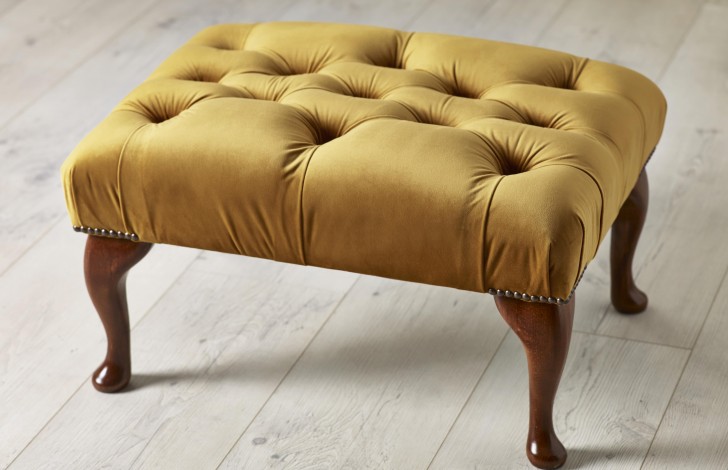
The stuffed stool on carved legsLong before the sofa, the upholstered stool carried the show cover and the cabriole leg into ordinary rooms.
Now · The Chesterfield Company
Queen Anne stoolA small footstool on carved cabriole legs in a choice of fabrics — the eighteenth-century form at its simplest.
See the Queen Anne stool →Then · 1805
The Grecian couchGillow’s single-ended couch for Kinmel Park: one high scrolled end, a squab, a bolster and animal legs.

Now · The English Sofa Company
Liberty leather chaise longueThe one-armed reclining seat, its bolster built into the scroll.
See the Liberty chaise →Then · 1810–1830
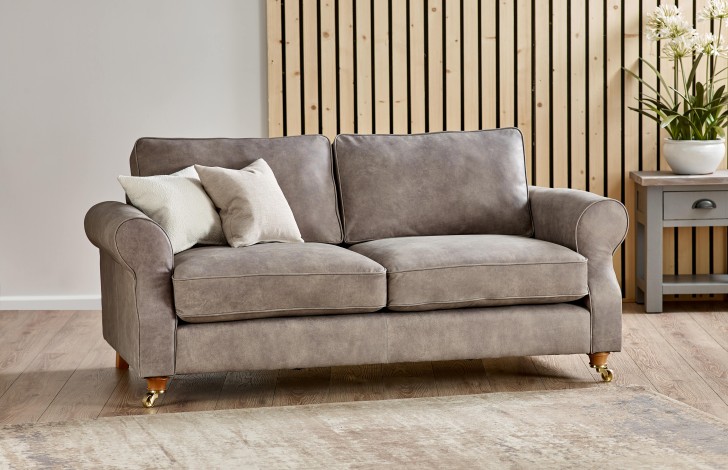
The Regency scroll armOutscrolled arms carved with lotus leaves at Windsor; diagonally banded scrolls on Soane’s mahogany sofa.
Now · The Chesterfield Company
Churchill scroll-arm sofaThe double-ended sofa with two equal scrolled arms and a plain straight back.
See the Churchill →Then · 1805–1830
The leather library chairChippendale the younger’s yellow-leather cushion at Stourhead: hide for the room that was used hardest.
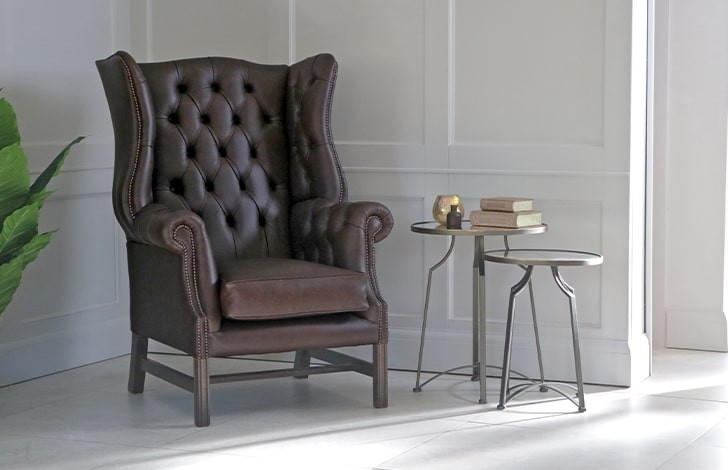
Now · The Chesterfield Company
Manchester fireside armchairA high-backed winged leather chair with feather-topped cushions — the study chair for the room that is used hardest.
See the Manchester →Modern pieces are shown for comparison only. Their frames are solid beech, their seats are sprung with serpentine springs and filled with foam, fibre or feather-wrapped cushions, and they carry a fifteen-year frame guarantee — a set of expectations that Pratt’s iron-wire seats of the 1820s only began to create.
Common misconceptions
“The first Chesterfield was commissioned by the Earl of Chesterfield.” A tradition, not a documented fact. Philip Dormer Stanhope, 4th Earl of Chesterfield (1694–1773), was a real Georgian patron — Roubiliac’s bust of him is in the V&A — but no museum or archive record cited here links him to a sofa, and the deep-buttoned, sprung leather sofa that carries his name depends on the coil spring, patented half a century after his death. The National Trust’s catalogued “Chesterfield” at Croft Castle is of unknown date. Treat the story as unverified.
“A Chippendale sofa is a sofa made by Chippendale.” Usually it is a sofa made from, or in the spirit of, the Director, whose subscribers included cabinet-makers throughout Britain and overseas. Documented pieces, such as the Nostell and Arlington Street commissions, are rare; most attributions rest on style.
“Georgian sofas were sprung.” None of the objects on this page was. Every recorded stuffing from 1732 to 1823 is horsehair on webbing, and the coil spring appears in Pratt’s beds and easy chairs only in the late 1820s.
“A chair-back settee is Georgian.” Many are, but the V&A warns that many surviving settees of the chinoiserie chair-back type were made between about 1850 and 1900. Look at the timber, joints and wear before the style.
Questions people ask
When did sofas become common in British homes?
In the early 1800s, according to the Museum of the Home, whose drawing room of 1830 is built around a sofa of about 1820. Before that a stuffed settee or sofa was a state-room or drawing-room piece for the wealthy; the museum’s parlours of 1745 and 1790 are furnished with wooden chairs and cushions rather than sofas.
What is the difference between a settee, a sofa and a couch in the Georgian period?
A settee was a chair form widened for two or more, often with open chair backs and show-wood arms; a sofa was fully stuffed over, with upholstered back and arms; a couch was single-ended for reclining, which is why the Regency’s Grecian couch is a couch and not a sofa. Makers and clients used the words loosely, and Chippendale’s 1765 bill calls armchairs “sopha chairs”.
How were Georgian sofas made?
On a show-wood frame of walnut, mahogany or gilded beech, the upholsterer stretched linen webbing, tacked a linen base cloth over it, laid horsehair on top, covered it with a linen stuffing case and stitched it through so the hair stayed put. A show cover of silk, horsehair cloth or leather was then nailed round the rails. The V&A’s Houghton chair of about 1732 keeps this construction intact.
What is a camelback sofa?
A mid-eighteenth-century sofa whose stuffed back rises in a serpentine curve to a hump at the centre, with rolled arms and cabriole or square legs. Chippendale published the form in The Gentleman and Cabinet-Maker’s Director, and the V&A holds his drawing for the rococo sofa that became plate 30 of the 1762 edition, complete with instructions on the sofa’s dimensions.
Who was Thomas Hope and what did he do for the Regency sofa?
Thomas Hope (1769–1831) was a Dutch-born collector whose London house in Duchess Street, opened to society in 1802, and whose book Household Furniture and Interior Decoration of 1807 set the pattern for Regency classicism. The V&A credits him with introducing the phrase “interior decoration” to English; his Greek, Roman and Egyptian sources are behind the animal legs, scrolled ends and bolsters of the Grecian couch.
When did coil springs arrive in sofas?
In the late 1820s and 1830s. The Furniture History Society records Samuel Pratt, a London upholsterer trading 1826–47, as the patentee of the coil upholstery spring under patents 5418 and 5668, advertising beds and easy chairs “stuffed with iron wire”. The date generally given is 1828. Georgian and Regency sofas before that were stuffed with horsehair and unsprung.
Are Georgian and Regency sofas comfortable to sit on?
Firmer than a modern sofa, because a stitched horsehair seat has no springs and was built to hold its shape rather than to give. Regency sofas added loose hair or feather squabs and bolsters, which is where most of the softness came from, and the Museum of the Home notes that sofas of the 1820s were much more comfortable than earlier seating. They are pleasant for sitting upright and reading; they are not for slumping.
Why were library chairs covered in leather?
Because leather withstood hard use and did not need protecting from hair powder or candle smoke. Thomas Chippendale the younger’s bill to Stourhead in 1805 lists library chair cushions in red cloth and one in yellow leather, and horsehair cloth served the same purpose on dining chairs. Silk stayed in the drawing room, usually under a loose chintz cover.
What modern sofa is closest to a Regency scroll-arm sofa?
A double-ended sofa with two scrolled arms of equal height, a straight back and a show-wood or castored base, made on a hardwood frame with a sprung seat. Several English makers still build this form in leather or fabric; the main differences from the 1820s original are the serpentine springs under the seat, the foam or fibre cushion fillings and the absence of a loose chintz cover.
Did the Earl of Chesterfield really commission the first Chesterfield sofa?
There is no documentary evidence for it in any museum or archive record cited on this site. The 4th Earl (1694–1773) was a real Georgian figure, but the deep-buttoned, sprung leather sofa that bears his name depends on the coil spring, which was not patented until the 1820s. The story should be treated as a tradition rather than a fact.
Sources
- V&A, settee from Glemham Hall, 1722, W.32-1970 — collections.vam.ac.uk/item/O372221
- V&A, sofa by Thomas Roberts junior for Houghton Hall, c. 1732, W.55-2002 — collections.vam.ac.uk/item/O80394
- V&A, chair by Thomas Roberts junior with original upholstery, c. 1732, W.30:1, 2-2002 — collections.vam.ac.uk/item/O80358
- V&A, The Gentleman and Cabinet-Maker’s Director, 1754, L.4674-1978 — collections.vam.ac.uk/item/O1427008
- V&A, Chippendale design for a rococo sofa, plate 30 of the 1762 Director, 2616 — collections.vam.ac.uk/item/O502321
- V&A, chinoiserie double-chair-back settee, c. 1750–75, W.66-1962 — collections.vam.ac.uk/item/O107395
- V&A, settee designed by James Stuart for Spencer House, 1759–65, W.1-1977 — collections.vam.ac.uk/item/O53096
- V&A, armchair designed by Robert Adam and made by Chippendale for Sir Lawrence Dundas, 1764–65, W.1-1937 — collections.vam.ac.uk/item/O11300
- V&A, Grecian couch by Gillow & Co for Kinmel Park, 1805, W.38:1 to 4-1930 — collections.vam.ac.uk/item/O79013
- V&A, “Trafalgar” chair, c. 1810, W.27:1, 2-1958 — collections.vam.ac.uk/item/O52959
- V&A, chair squab by Morel and Hughes for Northumberland House, 1823, W.46-1980 — collections.vam.ac.uk/item/O101033
- V&A, “Thomas Hope and the Regency style” — vam.ac.uk
- National Trust Collections, sofa attributed to Chippendale, Nostell Priory, c. 1765–70, NT 959772 — nationaltrustcollections.org.uk/object/959772
- National Trust Collections, the Kedleston drawing room sofas by John Linnell to Adam’s design, 1765, NT 108607.2 — nationaltrustcollections.org.uk/object/108607.2
- National Trust Collections, the Stourhead library armchairs by Thomas Chippendale the younger, 1805, NT 731671.1 — nationaltrustcollections.org.uk/object/731671.1
- National Trust, Places to find Chippendale’s work (Nostell, Saltram, Petworth) — nationaltrust.org.uk
- Royal Collection Trust, sofa by Morel & Seddon for George IV’s private apartments, Windsor Castle, RCIN 31374 — rct.uk/collection/31374
- Sir John Soane’s Museum, sofa in the South Drawing Room, early 19th century, XF223 — collections.soane.org/object-xf223
- Museum of the Home, Rooms Through Time: a parlour in 1745; a parlour in 1790; a drawing room in 1830 — museumofthehome.org.uk
- Furniture History Society, British and Irish Furniture Makers Online: Pratt, Samuel & Henry (1826–47), patentee of the coil upholstery spring — bifmo.furniturehistorysociety.org