Home · Edwardian
1901 – 1914
The Edwardian sofa: lighter rooms, matched suites and the return of show-wood
The Edwardian sofa is the Victorian one on a diet. Between the old Queen’s death and the outbreak of war the drawing room was lightened, the deep Chesterfield acquired loose cushions and washable covers, slender mahogany settees revived Sheraton and Adam, and the matched sofa-and-two-armchairs became the ordinary thing to buy.
In brief. Between 1901 and 1914 the British sofa shed its Victorian weight: rooms were lightened, the deep-buttoned settee kept its place but gained loose cushions and loose covers, and slender show-wood settees in mahogany and satinwood revived the look of Sheraton and Adam. The matched set — a sofa and two armchairs in the same cover — became the ordinary drawing-room purchase, and “Chesterfield” settled into use as a plain word for a deep-seated, arm-and-back-level sofa. Alongside all this, Arts and Crafts furniture moved from the workshop to the shop floor through Heal’s and Liberty, and the war of 1914 closed the period with the founding, in 1915, of the Design and Industries Association.
- The suite as a unit
- 1901–1910An Edwardian button-upholstered Chesterfield at Tyntesfield, covered to match its armchair
- “Chesterfield” as a generic word
- c. 1880–1910National Trust catalogues use it as an object type for sofas of these decades
- Sheraton revival
- c. 1910Mahogany with satinwood banding and ebony stringing, “in Sheraton style”
- Arts and Crafts on sale
- 1897–1914Clissett chairs sold by Heal’s; Walton and Punnett chairs for Liberty; Heal at the 1914 Paris exhibition
- Design and Industries Association
- 1915Founded by Brewer, Heal, Peach and Stabler after seeing the Werkbund at Cologne in 1914
What changed in the drawing room after 1901?
The Edwardian drawing room was, above all, less full. The Museum of the Home’s reconstruction of a townhouse parlour in 1878 shows the earlier taste — mint-green patterned wallpaper, red carpet, a red upholstered armchair draped with embroidery, a table under a heavy red cloth and a mantelpiece stacked with vases and framed pictures. The rooms of 1901–14 kept the bay windows and high ceilings but reduced the layers: fewer drapes, paler walls, more of the floor visible, and seating that stood on show-wood legs rather than hiding under fringe. The change was helped along by new services. At Dunham Massey in Cheshire the 9th Earl of Stamford modernised the house for his young family by installing electricity, central heating and the telephone, and from 1905 the architect Compton Hall and the furniture historian Percy Macquoid were commissioned to design what the National Trust calls its sumptuous Edwardian interiors. Electric light was still a luxury: the Science Museum notes that only six per cent of British homes had electricity in 1919, so for most families the Edwardian room was lit by gas or oil. Where it was electric, the whiter, steadier light showed dust and heavy colour without mercy, and pale chintzes, cane and polished mahogany suited it better than the plush and bobble-fringe of the 1870s.
It is worth being honest about who this applied to. The Museum of the Home’s tenement flat of 1913, furnished for the Delinsky family in the East End, holds a wooden dining table under a white cloth, two wooden chairs, a brass bed behind a curtain and a dresser of dishware. There is no sofa. The lighter drawing room described on this page belonged to the middle and upper classes; for a working family the upholstered three-piece suite was still a generation away.
Why do Edwardian settees look Georgian?
Because the trade had been reviving eighteenth-century design for a generation, and the Edwardians made it their own. The V&A bought a painted satinwood armchair from the liquidation sale of Wright & Mansfield in 1887 precisely to document high-quality reproduction furniture; the firm specialised in pieces based on the designs of Robert Adam, Thomas Chippendale, George Hepplewhite and Thomas Sheraton, and the museum observes that such furniture “evoked a background of established wealth and inherited furnishings”. That was exactly the effect a newly prosperous Edwardian household wanted. By 1910 the idiom was standard: a circular occasional table in the Museum of the Home, dated about 1910, is catalogued as “in Sheraton style”, its flame mahogany top cross-banded in satinwood with ebony stringing, on tapered legs with boxwood detail, spade feet and brass castors. The same vocabulary — mahogany show-wood, satinwood banding, boxwood or ebony line inlay, square tapered legs on spade feet or castors — ran across the drawing-room settees of the decade, whose upholstered seats and backs sat inside a slim visible frame instead of swallowing it.
Architects worked in the same key. Edwin Lutyens designed a set of twenty-one armchairs in 1905 for the board room of Country Life in Covent Garden, in ebonised and painted birch with horsehair upholstery, the oval back with radiating bars drawn from Hepplewhite. The other Georgian form the Edwardians adopted wholesale was the bergère: a chair or settee with caned sides and back and loose cushions. The type was Regency — a pair at Blickling of about 1810 have moulded mahogany frames, caned sides, brass castors and loose brown cotton sateen covers over soft-filled cushions — and Morris & Company were selling a close copy by 1893–95, designed by George Jack in mahogany and cane with two square-buttoned cushions in William Morris’s “Tulip” chintz. The V&A records that the chair was still in the firm’s catalogue in 1912. A cane bergère suite, three pieces in mahogany with loose cushions, was one of the characteristic purchases of the years before the war.
Milestone · 1901–1910
The three-piece suite
The habit of buying a sofa and two matching armchairs together — one cover, one frame style, one bill — hardened into the standard purchase in these years. The clearest museum evidence is at Tyntesfield in Somerset, where the National Trust catalogues “an Edwardian button upholstered Chesterfield sofa, covered with blue palmette patterned textile as used on an armchair”; the armchair is a late-Victorian walnut easy chair with a scrolled back, out-turned arms and bowed seat, in the same blue palmette cover under green cotton loose covers. At Kingston Lacy in Dorset a mahogany and beech Chesterfield of about 1900 stands on square-section legs and castors, the plain rectangular form that a suite could be built around. The National Trust records do not use the phrase “three-piece suite” for these pieces, and the earliest object in this survey actually catalogued as part of one is a Buoyant armchair of the 1930s in the Museum of the Home; what the Edwardian records show is the practice — matched covers across sofa and chairs — from which the named product grew.
Did Arts and Crafts furniture survive into the 1900s?
It did, and it changed from a movement into a range. In the Cotswolds Ernest Gimson and the Barnsley brothers, settled at Sapperton from 1893, kept to the ideals of visible construction, simple structures and limited decoration. Gimson had learned chairmaking in 1890 from Philip Clissett, a bodger of Bosbury in Herefordshire; his ladder-back armchair of 1892–1904 in the V&A is ash turned on a pole-lathe with riven ash splats and a rush seat, and after 1904 he stopped making chairs himself and left the work to his assistant Edward Gardiner. Ernest Barnsley’s wardrobe of 1902 came from the Daneway House workshops. C. F. A. Voysey, whose designs the V&A describes as deliberately simple and anticipating the “less is more” of modernism, designed twelve oak armchairs in about 1909 for the London offices of the Essex and Suffolk Equitable Insurance Company, with tall backs, leather seats on spring upholstery and a nailhead trim — a reminder that leather and springs belonged in the office as much as the club.
The shops did the rest. Ambrose Heal joined the family bedding business on Tottenham Court Road in 1893, won a silver medal at the Paris Exhibition of 1900 and became chairman in 1913; a Clissett-type ladder-back in turned ash with a rush seat, made for the Passmore Edwards Settlement in Bloomsbury in 1897–98, is catalogued by the V&A with Heal & Son as retailer. Liberty & Co commissioned independent designers and had the work made outside: George Walton’s “Lovat” armchair of 1899–1900 in walnut with a mother-of-pearl heart was made by William Birch of High Wycombe and retailed by Liberty, and an oak and walnut armchair of 1901 with rush panels and an ebony inlay, associated with E. G. Punnett at Birch, cost the maker £2 6s to produce — Arts and Crafts at a price a clerk could think about. The period closes with Heal’s own dining chair in walnut and mother-of-pearl, designed and made for the British Arts and Crafts exhibition at the Louvre in 1914.
Milestone · c. 1900–1914
The drop-arm settee and the Knole revival
The adjustable end came back. The original is the Knole sofa of about 1635–40 in Kent, a beech-framed state couch whose padded ends incline on iron ratchets and are tied to the back with cords; the National Trust quotes the historian R. W. Symonds, writing in 1945, that it “has been reproduced in tens of thousands by nearly every furniture manufacturer from Victorian to modern times”, and notes that the design was regularly copied and reinterpreted particularly from the Victorian period onwards. The Trust’s own copies show the shape the revival took: a pair at Hardwick Hall made by Eyres of Chesterfield in the first half of the twentieth century, in red velvet with gilt-metal braid and fringe; a “Knole-type” sofa at Bateman’s of about 1920 in oak and green velvet with fixed ends, a removable seat cushion and two loose cushions; three at Upton House of about 1930 in velvet and damask with squab seats and rope-tied finials. The Edwardian trade simplified the idea into the drop-arm or drop-end settee, one arm lowered on a ratchet or hinge so the seat became a day-bed — a form that would be sold in every high street by the 1920s. Be aware that the dated National Trust copies are mostly 1920–35; the Victorian and Edwardian start of the fashion rests on Symonds’s statement, not on a dated Edwardian object in these collections.
When did “Chesterfield” become a generic word?
By the Edwardian years it was simply a type of sofa. The National Trust uses “Chesterfield” as a catalogue object type, and the dated examples run straight through the period: a mahogany and beech-framed Chesterfield of about 1880 at Mompesson House with scrolled arms and turned legs on brass castors; a button-back Chesterfield of about 1890 at Lanhydrock in red leather on ring-turned walnut feet; the Kingston Lacy Chesterfield of about 1900; and the Tyntesfield suite of 1901–10. In each case the word describes a deep, sprung, upholstered sofa with arms and back of much the same height, buttoned or plain, on short turned or square legs — not a maker, a place or a patent. The tradition that a Lord Chesterfield commissioned the first one cannot be verified on any museum record consulted for this site, and should be read as a story, not a fact. What the records do show is a sofa whose Edwardian versions were lighter in the leg, often in printed cotton rather than leather, and increasingly sold with loose cushions and a loose cover.
Materials: what went where, and why
| Period | Frame | Filling | Cover | Construction |
|---|---|---|---|---|
| Show-wood settee, c. 1900–14 | Mahogany show-wood; satinwood banding, ebony or boxwood stringing; beech seat rails | Hair and fibre over springs | Silk, damask, printed cotton | Upholstered panels inside a visible frame; tapered legs, spade feet or castors |
| Chesterfield, c. 1880–1910 | Mahogany or walnut show-wood on a beech frame | Hair over coil springs; deep buttoning | Leather; patterned wool or cotton; loose covers over | Buttoned back and arms; turned or square legs; brass castors |
| Bergère, 1893–1912 | Mahogany | Loose cushions, soft filled | Cane; chintz cushions; cotton sateen loose covers | Caned sides and back; square-buttoned cushions; castors |
| Arts and Crafts, 1892–1914 | Ash, oak, walnut | Rush; or springs under leather | Rush; leather with nailheads; mother-of-pearl or ebony inlay | Pole-lathe turning; riven splats; exposed joints |
| Knole-type, c. 1920–35 | Oak or beech, largely hidden | Removable squab and loose cushions | Velvet, damask, applied tapestry | Fixed or drop ends; braid; rope-tied finials |
Leather or fabric?
The Edwardians drew the line by room. Leather went where men smoked and where the public sat: Voysey’s insurance-office chairs of 1909 have leather seats on springs with nailhead trim, and the Lanhydrock Chesterfield of about 1890 is red leather on walnut. In the drawing room fabric won, and the fabric was increasingly printed cotton. Liberty sold “Chatsworth” in 1909, a design of fruiting and flowering trees by Sidney Mawson, hand block-printed by Turnbull & Stockdale in Lancashire and retailed under Liberty’s name; the V&A holds a run of the firm’s furnishing cottons of about 1910 — “Plumbago Trellis”, “The Beauly”, “Claremont”, “Field Flowers”, “Poppyland”. Such cloths were light enough to make loose covers, and loose covers are the Edwardian habit the records keep returning to: green cotton over the blue palmette at Tyntesfield, brown cotton sateen over the Blickling bergère cushions. A loose cover let the fixed upholstery be a good silk or damask and the everyday surface a washable print — and it let a family change the look of a suite for the price of the cloth.
How were Edwardian sofas sold?
Through shops that were becoming brands, and through the post. Heal & Son had traded on Tottenham Court Road for generations before Ambrose Heal turned it into a design house, and its new building of 1916, designed by his cousin Cecil Brewer, was the direct outcome of the Edwardian decade’s growth. Liberty’s method — commission the design, subcontract the making, sell under the shop’s name without crediting either — is documented across its V&A furniture and textiles. The V&A’s National Art Library holds the illustrated catalogue of Norman & Stacey of London, sixty-five pages of “artistic furniture, decorations, carpets and antique” of about 1910, and the Harrods catalogue of 1915, a volume of 1,448 pages with an edition for Buenos Aires: a customer in Surrey or Argentina could choose a suite from a page and have it delivered. At the very top, decoration was a professional job. Margaret Greville bought Polesden Lacey in February 1907, spent £80,000 on it, and employed Mewès and Davis, architects of the Ritz, with the decorators White, Allom & Co to make her a saloon in which, she said, she could entertain maharajas.
What ended the period?
The war, and a committee. In 1914 Cecil Brewer, Ambrose Heal, Harry Peach and Harold Stabler visited the Deutscher Werkbund exhibition at Cologne and came home convinced that Britain needed an equivalent body; in 1915 they founded the Design and Industries Association to stimulate high standards of design in industry through exhibitions, publications and educational pressure. Its early work grew out of Arts and Crafts but its direction was towards the factory, and it is the hinge between the Edwardian drawing room and the inter-war one. The sofas made after 1918 — Knole-type settees with loose cushions, Chesterfields in chintz, bergère suites — were the Edwardian forms continued, but they were made and sold by firms that had accepted the DIA’s premise that good design and machine production were not enemies.
What survives in a sofa made today
Five Edwardian ideas are still in production. The comparisons below pair each with a piece made in England today; neither maker offers a show-wood Sheraton-revival settee or a Knole, so in those cases the nearest form is shown and the difference explained.
Then · 1900–1930
The Knole revivalHigh padded ends level with the back, copied by the thousand from the state couch at Knole — usually with cords and finials, sometimes with the ratchets left out.

Now · The English Sofa Company
Beckworth sofa bedThe nearest shape made today: arms carried up to the height of the back, gently curved rather than tied, on a solid hardwood frame with a pull-out bed. No maker in this lineage makes a true drop-arm.
See the Beckworth →Then · 1901–1910
The matched suiteThe Tyntesfield Chesterfield and its armchair share one blue palmette cover — sofa and chairs bought as a set.

Now · The English Sofa Company
Ludlow setteeA compact two-seat Chesterfield settee on a solid beech frame, made to be ordered with matching chairs. Neither maker builds a show-wood Sheraton-revival settee; this is the nearest Edwardian-scale sofa.
See the Ludlow →Then · c. 1900
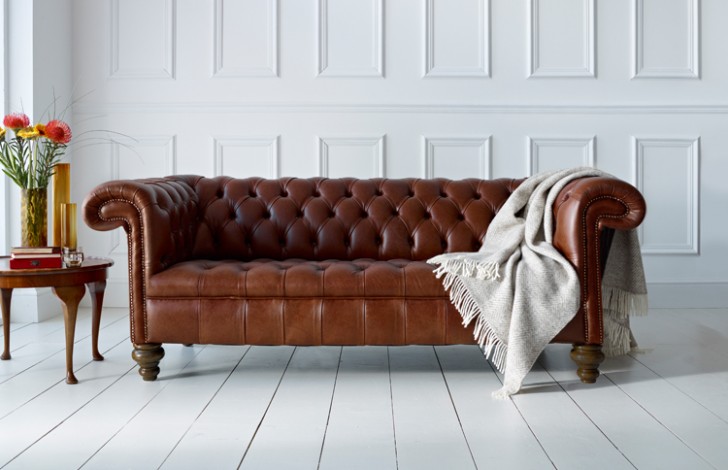
The plain ChesterfieldThe Kingston Lacy sofa: mahogany and beech, square-section legs on castors, arms and back level.
Now · The Chesterfield Company
Berwick straight-arm ChesterfieldThe same level arm and back in vintage leather, on a solid beech frame with serpentine springs.
See the Berwick →Then · c. 1909–1910
Printed cotton in the drawing roomLiberty’s block-printed furnishing cottons of 1909–13 and the loose covers that used them.

Now · The English Sofa Company
Elizabeth fabric wingbackA traditional wing form in fabric — the Edwardian answer of a patterned cloth on an old shape.
See the Elizabeth →Then · 1905–1914
The Georgian-revival dining chairLutyens’s Hepplewhite-inspired boardroom chairs of 1905; Heal’s walnut dining chair for Paris in 1914.

Now · The English Sofa Company
Manor buttoned dining chairAn upholstered, buttoned dining chair on show-wood legs — the eighteenth-century outline the Edwardians revived.
See the Manor →Then · 1893–1912
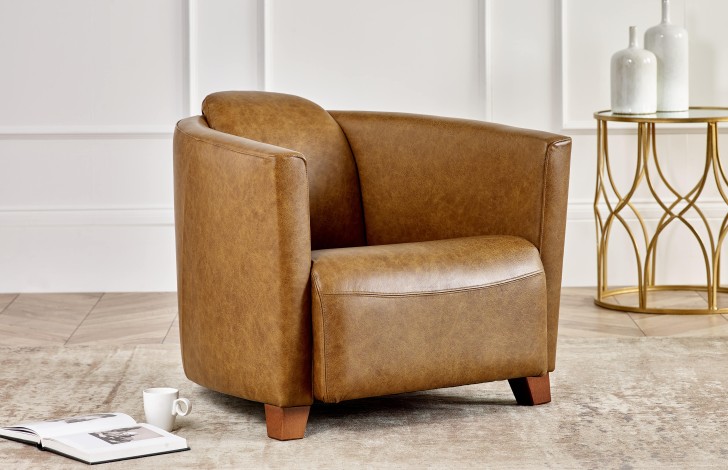
The bergère and the tubGeorge Jack’s caned bergère for Morris & Co, sold until 1912: a low, enclosing chair with loose cushions.
Now · The Chesterfield Company
Hudson tub chairNeither maker offers a caned bergère; the Hudson is the enclosing curved-back chair in leather, without the cane.
See the Hudson →Modern pieces are shown for comparison only. Their frames are solid beech and their seats sprung with serpentine springs and filled with foam, fibre or feather-wrapped cushions; no Knole, drop-arm or show-wood Sheraton-revival settee is made by either company, which is why the nearest forms are shown instead.
Common misconceptions
“The three-piece suite was invented in the 1930s.” The named product was marketed then — a Buoyant suite armchair of the 1930s is in the Museum of the Home — but the practice of covering a sofa and its armchairs alike is documented at Tyntesfield for 1901–10, and the plain Chesterfield it was built around was on sale by 1900.
“Edwardian furniture is just Victorian furniture.” The forms overlap, but the taste reversed: the 1878 townhouse parlour is red, layered and full; the rooms of 1901–14 are paler, emptier and stand on visible mahogany legs. The Museum of the Home’s c. 1910 table “in Sheraton style” is the idiom in one object.
“A Chesterfield is a leather sofa.” Not necessarily. Of the National Trust’s dated Chesterfields of 1880–1910 only the Lanhydrock example is leather; the Mompesson, Kingston Lacy and Tyntesfield sofas are in textile, and the Tyntesfield suite wore loose cotton covers.
“The Knole revival was Edwardian.” Partly. Symonds said the copying ran from Victorian times, but the dated National Trust copies — Hardwick, Bateman’s, Upton, Trerice — are 1900–35, mostly the 1920s and 1930s. The Edwardian contribution was the simpler drop-arm settee, which the museum records do not date precisely.
Questions people ask
When did the three-piece suite become standard?
The practice is documented in the Edwardian decade. The National Trust catalogues a button-upholstered Chesterfield of 1901–10 at Tyntesfield covered in the same blue palmette textile as its armchair, and a plain mahogany Chesterfield of about 1900 at Kingston Lacy. The name “three-piece suite” belongs to the inter-war trade, but the matched sofa and armchairs were an Edwardian purchase.
What is the difference between an Edwardian settee and a Victorian sofa?
Weight and visibility of the frame. A Victorian sofa hid its frame under fringe and deep buttoning; an Edwardian settee showed polished mahogany, often with satinwood banding and line inlay, on tapered legs with spade feet or castors, with upholstered panels set inside the frame. Rooms were paler and less cluttered, and printed cottons replaced plush.
What is a Sheraton revival settee?
A late nineteenth- and early twentieth-century settee made in the manner of Thomas Sheraton’s designs of the 1790s: slim mahogany show-wood, satinwood cross-banding, boxwood or ebony stringing and square tapered legs. The V&A documents the reproduction trade from the 1880s, and the Museum of the Home holds a c. 1910 table it catalogues as “in Sheraton style”.
How were Edwardian sofas made?
On a beech frame with mahogany or walnut show-wood, webbed and sprung with coil springs, stuffed with hair and fibre and covered in leather, wool, silk or printed cotton. Deep buttoning continued on Chesterfields; bergères used caned sides with loose, soft-filled cushions; and loose cotton covers were fitted over the fixed upholstery for everyday use.
What is a bergère suite?
A settee and armchairs with caned sides and back and loose cushions, in the Regency manner. The National Trust has a Regency pair of about 1810 at Blickling, and Morris & Co sold a mahogany and cane bergère with chintz cushions from 1893 until at least 1912. Cane suites were a characteristic Edwardian drawing-room purchase.
Was “Chesterfield” a brand name in 1910?
No. By then it was a plain word for a deep, sprung sofa with arms and back at about the same height. The National Trust uses it as an object type for sofas of about 1880, 1890, 1900 and 1901–10. The story of a Lord Chesterfield ordering the first one cannot be verified in any museum record and should be treated as tradition.
What is a drop-arm or drop-end settee?
A settee with one or both arms that lower on a ratchet or hinge so the seat becomes a day-bed. The idea descends from the ratcheted ends of the Knole sofa of c. 1635–40, which the National Trust says was reproduced in tens of thousands from Victorian times; the Trust’s dated copies run from about 1900 to the 1930s.
Are Edwardian sofas comfortable and worth buying?
Generally yes for the sprung, deep-seated types; show-wood settees are firmer and shallower. Frames are beech and usually sound, but hair and spring upholstery of this age will normally need rebuilding, which costs more than the frame. Cane on bergères is often replaced. Buy for the frame and the show-wood, and budget for the upholstery.
What modern sofa is closest to an Edwardian Chesterfield?
A straight-armed, level-backed Chesterfield on a beech frame, in leather or fabric, is the direct descendant of the plain Edwardian Chesterfield of about 1900. Modern versions use serpentine rather than coil springs and foam, fibre or feather-wrapped cushions. No maker cited on this site currently produces a show-wood Sheraton-revival settee or a Knole.
What was the Design and Industries Association?
A body founded in 1915 by Cecil Brewer, Ambrose Heal, Harry Peach and Harold Stabler after they saw the Deutscher Werkbund exhibition at Cologne in 1914. Its aim was to raise design standards in industry through exhibitions, publications and educational pressure, and it marks the shift from Arts and Crafts workshops to designed factory furniture.
Sources
- National Trust Collections, Chesterfield sofa, Tyntesfield, 1901–1910, NT 10568; matching easy armchair with loose covers, NT 10566 — nationaltrustcollections.org.uk/object/10568
- National Trust Collections, Chesterfields c. 1880–1900: Mompesson House NT 724184; Lanhydrock (leather) NT 882698; Kingston Lacy NT 1254763 — nationaltrustcollections.org.uk/object/1254763
- National Trust Collections, The Knole Sofa, NT 129442 (Symonds quotation) — nationaltrustcollections.org.uk/object/129442
- National Trust Collections, Knole copies: Hardwick Hall by Eyres of Chesterfield NT 1128068.1; Bateman’s c. 1920 NT 760863; Upton House c. 1930 NT 446498 — nationaltrustcollections.org.uk/object/1128068.1
- National Trust Collections, bergère chair, Blickling, c. 1810, NT 354170.1 — nationaltrustcollections.org.uk/object/354170.1
- National Trust Collections, Dunham Massey (Compton Hall, Percy Macquoid, 1905); National Trust, History of Dunham Massey — nationaltrustcollections.org.uk/place/dunham-massey
- National Trust, History of Polesden Lacey (1907 purchase, Mewès and Davis, White Allom) — nationaltrust.org.uk
- V&A, armchair, Wright & Mansfield, 1886–87, 240:1, 2-1887 — collections.vam.ac.uk/item/O61208
- V&A, bergère by George Jack for Morris & Co, 1893–95, CIRC.249 to B-1961 — collections.vam.ac.uk/item/O61444
- V&A, armchair by Lutyens for Country Life, 1905, W.6-1944 — collections.vam.ac.uk/item/O50993
- V&A, armchair by Voysey, c. 1909, CIRC.517-1954 — collections.vam.ac.uk/item/O118739
- V&A, ladder-back armchair by Ernest Gimson, 1892–1904, CIRC.232-1960; article “Arts and Crafts: design for the home” — collections.vam.ac.uk/item/O15900
- V&A, Heal & Son: Clissett armchair 1897–98, CIRC.511-1962; dining chair for Paris 1914, W.83:1, 2-1975 — collections.vam.ac.uk/item/O130479
- V&A, Liberty & Co: “Lovat” armchair by George Walton 1899–1900, W.77-1975; armchair, Punnett / William Birch 1901, CIRC.400:1, 2-1959 — collections.vam.ac.uk/item/O371694
- V&A, “Chatsworth” furnishing fabric, Liberty, 1909, CIRC.415-1966 — collections.vam.ac.uk/item/O85553
- V&A National Art Library, Norman & Stacey trade catalogue c. 1910, L.601-1967; Harrods catalogue 1915 — collections.vam.ac.uk/item/O1725980
- Museum of the Home, occasional table “in Sheraton style”, c. 1910, 34/2000; Buoyant suite armchair 1930–40, 267/1998-1 — collections.museumofthehome.org.uk/object28261
- Museum of the Home, Rooms Through Time: a townhouse in 1878; a tenement flat in 1913 — museumofthehome.org.uk
- Science Museum, Electrifying: the story of lighting our homes (6% of homes electrified, 1919) — sciencemuseum.org.uk
- English Heritage, Ambrose Heal blue plaque; Archives Hub (Jisc), Design and Industries Association records — english-heritage.org.uk